
As energy prices fluctuate and sustainability targets grow sharper, Bedford’s households and organisations are turning to battery storage to take control of their power. By capturing electricity when it’s cheapest or most abundant and releasing it when costs climb, modern systems build resilience, trim bills, and unlock more value from solar panels. From terraced homes in Castle Quarter to warehouses along the A421 corridor, carefully specified batteries help reduce grid reliance, provide backup power for critical circuits, and support carbon-cutting goals without compromising day-to-day operations. This guide explores how solar battery systems work, where they deliver the biggest gains in Bedford, and what to consider when planning an installation that is efficient, compliant, and ready for the future.
How Battery Storage Works and Why It Matters in Bedford
At its core, a home or commercial battery stores surplus electricity—typically from solar PV during the day or from the grid during off-peak hours—and discharges it when on-site demand rises or tariffs peak. Systems come in two main architectures. Hybrid inverters integrate directly with solar arrays, routing generation to the battery or to appliances with minimal conversion losses. AC-coupled solutions add storage to an existing solar setup or operate independently, making them ideal for retrofits in Bedford properties that already have panels.
Capacity (measured in kWh) and power (kW) determine how long and how fast a battery can supply your site. For many Bedford homes, 5–10 kWh suits evening use and cooking loads; larger households might opt for 10–20 kWh, especially with EV charging. Round-trip efficiency—often 90%+ with modern lithium-ion chemistries—affects the net savings. Depth of discharge, cycle life, and smart controls influence longevity and value. Quality systems offer 10-year warranties with projected capacities after thousands of cycles, helping forecast lifetime returns with confidence.
Local tariff structures make Battery Storage in Bedford particularly compelling. Time-of-use plans reward shifting consumption away from peak periods; batteries automate this by charging at low-cost times and discharging when rates rise. With solar, storage boosts self-consumption, enabling homes to use more of their own generation rather than exporting at lower rates. For SMEs, demand reduction and peak shaving can bring meaningful savings, especially where operations cluster around late afternoon spikes.
Resilience is another driver. While Bedford enjoys strong network reliability, occasional outages do occur—often weather or maintenance related. Configured with backup functionality, a battery can maintain lighting, refrigeration, IT equipment, and security systems on a protected circuit. In settings where uptime matters—home-working setups, retail tills, server rooms—this backup power adds peace of mind without the noise or emissions of a generator.
Safety and compliance sit at the heart of a good design. UK installations should follow BS 7671 (18th Edition) and, where export is involved, meet G98 or G99 requirements, with DNO approvals handled before commissioning. In Bedfordshire, the relevant DNO is UK Power Networks. Suitable siting—often a garage, utility room, or plant area—ensures correct clearances, ventilation, and cable routes, reducing installation complexity and maintaining system performance year-round.
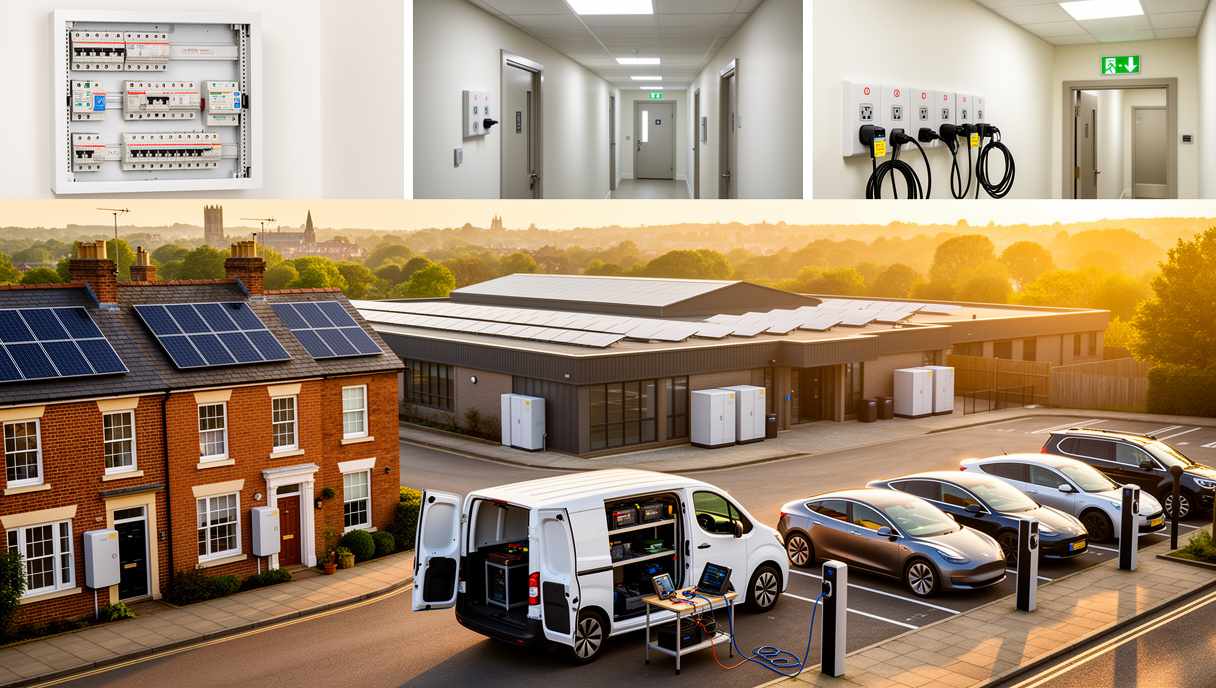
Practical Use Cases: Homes, Shops, Schools and Industrial Units
Every site in Bedford has a different energy profile, and battery storage adapts to each one. Consider a semi-detached family home in Great Denham with 4 kWp of solar and evening peaks from cooking, showers, and TV time. A 7–10 kWh battery can capture midday solar, cover the dinner rush, and still top up an EV during off-peak hours, cutting grid imports by 30–60% depending on lifestyle and season. If a brief outage occurs, a protected circuit keeps essentials running until power is restored.
In a Bedford High Street shop, peak consumption may align with trading hours and lighting loads. A compact 5–8 kWh system can trim the late-afternoon tariff window, smoothing bills and supporting refrigeration or point-of-sale equipment during short interruptions. Smart scheduling helps the owner capitalise on time-of-use plans, and granular monitoring reveals where small operational tweaks—staggered appliance use, for example—enhance savings further.
Schools and community facilities in areas like Bromham or Wootton often face two challenges: daytime solar surplus during holidays and pronounced spikes when activities peak. A 20–40 kWh installation can bank midday generation for late-afternoon clubs, reducing expensive peak imports while ensuring critical lighting and ICT systems are protected. Over time, the data insights from the battery management platform help facility managers refine settings and justify additional measures such as LED upgrades or load shifting.
Industrial units around Kempston or Elstow might combine 30–100 kWh (or more) with rooftop PV to manage heavy start-up currents, smooth production peaks, and secure a buffer for power quality. Even where export revenue is modest, the blend of peak avoidance, improved self-consumption, and resilience often delivers strong returns. For businesses with EV fleets, batteries can soak up daytime solar and dispense it for early-evening charging, easing strain on incoming supplies and avoiding costly capacity upgrades.
Real-world results in Bedford hinge on an accurate survey: half-hour load analysis, an assessment of roof orientation and shading for solar, and an understanding of operational rhythms. With a tailored design, homeowners and managers can confidently invest in Battery Storage in Bedford, knowing capacity, inverter choice, and control strategies match their actual needs—not a one-size-fits-all estimate. The outcome is a system that feels invisible in daily life yet reliably trims costs, curbs carbon, and strengthens continuity.
Planning, Safety, and Getting the Best from Your System
Successful projects start with a conversation about goals: bill reduction, resilience, or both. A Bedford-focused survey looks at typical daily loads, seasonal changes, and the compatibility of existing solar inverters. From there, designers propose AC-coupled or hybrid systems, recommend battery chemistry and capacity, and model savings under realistic tariffs and weather data. For properties prioritising backup power, the plan identifies protected circuits—lighting, broadband router, key sockets—so emergency supply is targeted and cost-effective.
Compliance and permissions are essential. Where export is present, the installer will pursue G98 (smaller systems) or G99 (larger/complex systems) approvals with the DNO—UK Power Networks for Bedfordshire—and provide electrical certification upon completion. Best practice includes appropriate fire safety measures, correct cable sizing and protection, and adherence to manufacturer siting guidelines. Quality batteries incorporate battery management systems (BMS) with cell-level protection, and reputable brands provide documented testing to relevant standards, reinforcing safety and reliability across the system’s lifetime.
Cost and incentives matter, too. Domestic customers in Great Britain currently benefit from 0% VAT on the supply and installation of many energy-saving measures, including qualifying battery storage, subject to ongoing government rules. Savings also improve when batteries complement solar under the Smart Export Guarantee, or when time-of-use tariffs allow strategic charging overnight. A good design weighs these dynamics, calibrating charge/discharge windows and reserve levels so you’re not exporting cheaply at noon and buying back expensively at 6 pm.
Once installed, monitoring apps provide live and historical data on consumption, solar generation, state of charge, and grid exchange. Set-and-forget profiles are popular, but seasonal adjustments can lift returns—slightly higher reserves for winter evenings, for example, or opportunistic charging during tariff “flash” windows. For businesses, reports reveal peak demand trends and help justify operational shifts or targeted equipment upgrades that compound the battery’s benefits.
Maintenance is light: visual checks, firmware updates, and periodic reviews of settings to reflect changing habits—say, a new EV or home office setup. Most systems are warrantied for around a decade; after that, usable capacity typically remains, extending value even as output slowly tapers. End-of-life pathways and recycling are improving, with responsible installers following WEEE and manufacturer guidelines to minimise environmental impact.
For Bedford homes and organisations, the big win is control. By aligning capacity, placement, smart controls, and compliance with local network requirements, battery storage turns energy from a fixed cost into a managed asset. Whether you prioritise security during outages, consistent bills for a growing business, or making the most of Bedford’s sunny days on a south-facing roof, a well-designed system delivers dependable, long-term results that feel effortless day to day.

Sofia cybersecurity lecturer based in Montréal. Viktor decodes ransomware trends, Balkan folklore monsters, and cold-weather cycling hacks. He brews sour cherry beer in his basement and performs slam-poetry in three languages.