
Every wash pad that handles trucks, heavy equipment, or industrial parts confronts the same challenge: oily runoff that can foul sewers, pollute storm drains, and trigger fines or shutdowns. The device that keeps you out of trouble and your water cleaner is the oil-water separator. When paired with smart collection and filtration, it protects pumps, meets permit limits, extends equipment life, and helps you wash responsibly under the Clean Water Act. Understanding how separators operate—and how to integrate and maintain them—can transform a messy liability into a controlled, compliant workflow.
How an Oil-Water Separator Works and Why It Matters
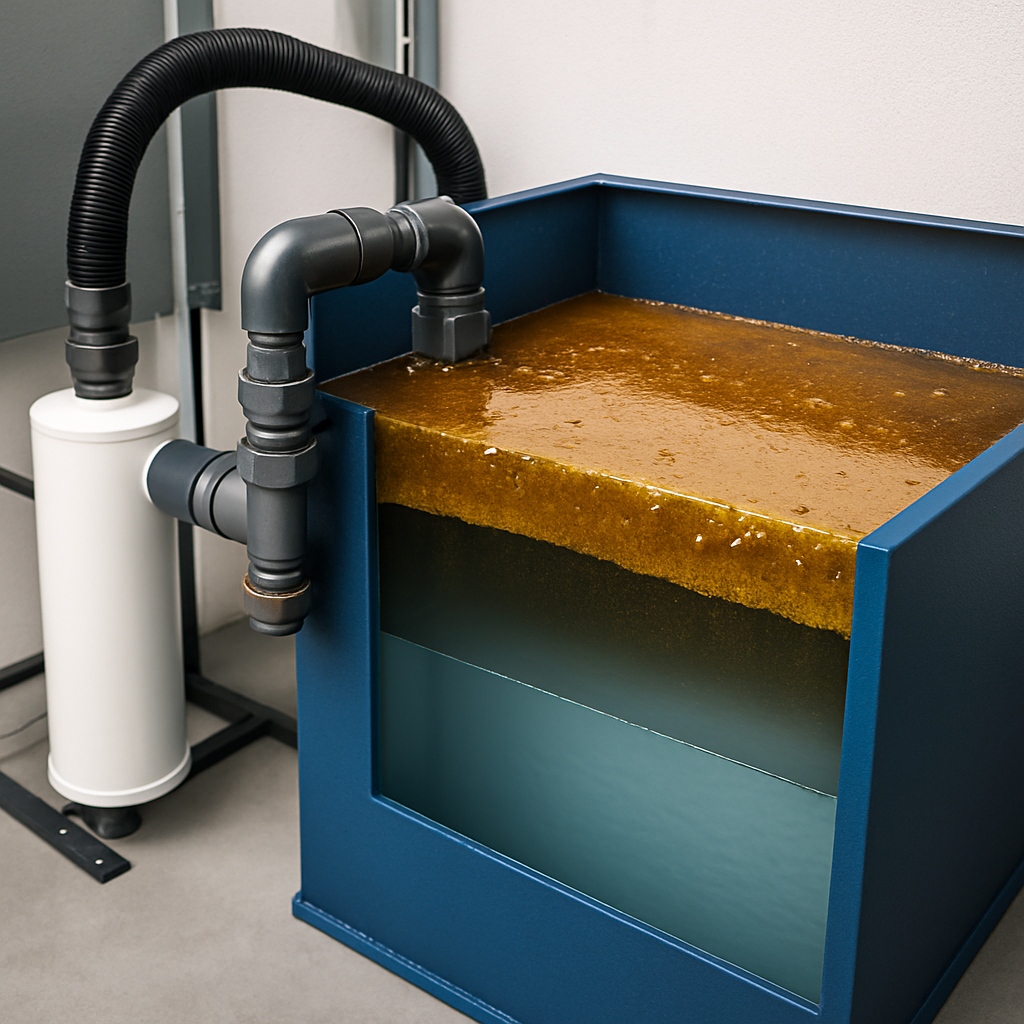
An oil-water separator uses physics to do its job. Most rely on gravity: water is denser than petroleum hydrocarbons, so free and dispersed oil droplets rise while solids settle. In a simple API-style tank, flow slows down to allow droplets to coalesce and float to a skimming zone, while grit and sludge drop to the bottom for periodic removal. More advanced coalescing plate interceptors (CPI) and media-style units add structured surfaces that encourage small droplets to merge into larger ones that separate faster, improving performance in a smaller footprint.
Real-world wash water is rarely simple, so design and operation matter. Temperature, viscosity, and flow rate all affect the separation time. If you rush water through a small tank, you’ll push oil out with the effluent. If detergents or high-pressure cleaning create emulsions, droplets stay suspended and resist gravity. That’s why maintenance and upstream practices—like using low-foaming, separator-friendly soaps and avoiding solvent-heavy degreasers—are just as important as the tank itself.
Performance is typically measured in mg/L (ppm) of oil and grease (O&G). Municipalities and industrial dischargers commonly target effluent in the 5–30 mg/L range, while NPDES stormwater permits often require best practices that keep sheen and visible contamination out of outfalls. Many separators are installed ahead of further treatment—bag/cartridge filters, sand filters, carbon, or reclaim systems—so they act as the essential first cut that removes the bulk of free oil and protects downstream media from blinding and fouling.
It’s helpful to align your separator to your wash rack reality. Light-duty fleets often do well with compact CPI units. Heavy construction equipment, refuse packers, and sweepers shed more mud and hydraulic oil, so they benefit from robust pre-settling and larger coalescing volumes. Cold climates can thicken oil and slow rise rates; heaters or insulated enclosures can keep separation effective year-round. Whether you discharge to sanitary sewer, recycle, or flow to a stormwater treatment train, the right oil-water separator is foundational to staying compliant and controlling operating costs.
Designing a Wash Rack System Around the Separator
Successful separation starts before the first drop hits the tank. Good collection, containment, and solids control upstream of the separator make or break performance. A graded pad or trench drain funnels water to a sump where a trash basket or bar screen catches large debris—gravel, zip ties, rags, brush bristles—that otherwise clog pumps and coalescing media. From there, a pump feeds an equalization (EQ) chamber to dampen surges. This smoothed flow gives the separator a consistent loading rate that matches its rated gallons per minute (GPM).
Right-sizing the separator is essential. Engineers consider peak spray rates, expected oil load, and total suspended solids (TSS). Oversized units occupy space and cost more than necessary, but undersized units are the fastest path to carryover and sheen. For mobile or temporary sites, compact skid systems integrate the EQ tank, separator, and controls; for permanent bays, in-ground tanks with easy access for sludge cleanout can minimize footprint while keeping maintenance safe and efficient.
From the separator, many sites route effluent through polishing steps. Bag filters catch fine sediment that escapes settling. Activated carbon tackles residual hydrocarbons and odors. If water is being reused, a reclaim loop may add aeration, biological media, or ozone/UV to control odor and biological growth. In freezing regions, heat tracing and insulated enclosures prevent ice that can crack valves and freeze skimmers. In hot regions, shading and ventilation limit VOCs and keep equipment from overheating.
Controls matter as much as hardware. Level sensors prevent pumps from running dry and protect skimmers. Flow meters help verify the system is within design limits. A simple panel can alarm for basket overloads, high sludge levels, or coalescer fouling so operators act before there’s an overflow or compliance issue. Finally, build for service: quick-release plates for media access, hose bibs for rinsing, and clear, labeled piping. A separator that’s hard to clean becomes a separator that isn’t cleaned—leading to performance drift and costly callouts.
Maintenance, Compliance, and Real-World Scenarios
Oil-water separators are reliable when treated like the process equipment they are. The fundamentals are straightforward: inspect weekly, skim the oil reservoir before it overflows, remove settled sludge on a scheduled basis, and rinse coalescing media when differential pressure rises or visual inspection shows significant fouling. Keep a logbook with dates, volumes removed, and observations. These records help prove due diligence under stormwater or industrial pretreatment programs and make budgeting predictable.
Upstream best practices reduce separator workload dramatically. Sweep or vacuum pads before washing to keep sand and grit out of the sump. Use spill pans under leaky hydraulics and clean drips with absorbent pads rather than blasting them into drains. Choose separator-friendly detergents with low emulsifying potential. Control pH: extremes can destabilize media and interfere with downstream polishing. Train crews to recognize when wash water looks milky (emulsified) versus clear with a surface sheen (free oil) and to escalate when conditions change.
Consider three scenarios. A municipal public works yard washes salt and brine from plow trucks each winter. Here, corrosion control is paramount, but so is compliance. A grated pad with robust solids capture keeps sand out of pumps, while a CPI separator followed by bag filters lets the city reuse water between storms, cutting hydrant consumption and sewer fees. Because cold water slows oil rise, the site insulates the separator and adds a small recirculation heater, preventing winter carryover that would create visible sheen at the outfall.
A construction company services dozers and compactors loaded with clay and hydraulic oil. The team installs an oversized sump and periodic sludge hauling to manage heavy TSS. They switch from a solvent degreaser to a biodegradable, low-emulsion detergent, and separator performance jumps from chronic sheen to clean effluent. They also add a simple oil content test kit for spot checks after heavy maintenance events. In six months, the site logs zero violations and reduces pump rebuilds thanks to cleaner water in the reclaim loop.
Finally, a refuse hauler with frequent leaks and odor issues pairs its separator with carbon polishing and aeration. Odors drop, neighbors stop complaining, and insurance auditors flag the improved controls as a positive risk factor. The company formalizes monthly inspections and annual media change-outs, locking in predictable O&M costs. Across all three examples, the pattern holds: the separator delivers when solids are managed, chemistry is compatible, and maintenance is proactive.
What about tough cases? If surfactants from aggressive washing create stable emulsions, gravity alone may not reach permit limits. Options include reducing detergent strength, adding a flocculant/coagulant step, or incorporating dissolved air flotation (DAF) upstream of the separator. Where sheen persists due to trace hydrocarbons, a finishing step with organoclay or high-capacity carbon can polish to non-detect levels. In coastal regions prone to storms, secondary containment and bypass controls prevent wash water and oils from escaping during heavy rain events—an important consideration under NPDES-related stormwater requirements.
In every case, the economics favor disciplined operation. Avoiding fines, spill responses, and emergency pump-outs saves cash and downtime. Cleaner equipment lasts longer; salt, brine, and grime are harsh on frames, wiring, and hydraulics. Strong documentation satisfies regulators and customers alike. With the right sizing, upstream controls, and planned maintenance, an oil-water separator turns a complex environmental risk into a steady, manageable process that supports safer, more responsible, and cost-effective washing.

Sofia cybersecurity lecturer based in Montréal. Viktor decodes ransomware trends, Balkan folklore monsters, and cold-weather cycling hacks. He brews sour cherry beer in his basement and performs slam-poetry in three languages.