
From Reflection Nightmares to Studio-Perfect Imagery: Why AI Fits Jewellery
Photographing jewellery has always been a paradox. The very qualities that make fine pieces mesmerizing in person—mirror-like metals, scintillating facets, micro-detail—make them notoriously difficult to capture consistently on camera. Reflections turn into visual clutter, gemstones lose fire under flat light, and minute manufacturing details can vanish or distort at web resolution. AI jewellery product photography solves these pain points by combining physics-aware rendering, learned material behavior, and automated retouching to produce images that appear handcrafted by a senior studio team, at a fraction of the cost and time.
Modern AI workflows excel because they understand materials. Algorithms trained on metals, stones, and enamel learn how to preserve true color, specularity, and micro-contrast. Rings, pendants, and watches can be relit to maintain the crisp edge highlights that communicate premium craftsmanship, while generative backgrounds keep reflections believable and coherent. Even better, AI can harmonize entire collections with identical camera angles, shadows, and color balance—critical for grid pages and catalogues where inconsistency erodes trust and conversion.
What makes this shift transformative is input flexibility. Whether starting with a quick smartphone snapshot, a factory CAD file, or a design sketch, AI systems can upscale to 2K and 4K, apply material-accurate textures, and output clean packshots or multi-angle sets tuned for marketplaces and e-commerce PDPs. Lifestyle imagery—on-model, in-situation, or editorial—can be generated to brand style, without the logistics of location scouting, crews, and re-shoots for every variant in rose, white, or yellow gold.
AI also addresses the micro-decisions that make jewellery visuals credible. Prong reflections, diamond scintillation, and pavé sparkle can be preserved without the plastic sheen that plagues quick retouching. Chains look natural rather than rigid. Engravings and hallmarks remain legible at thumbnail size. Color fidelity—a frequent source of returns—is tuned via reference swatches and calibrated output, aligning screen presentation with in-hand perception.
For artisans, designers, and luxury retailers under pressure to launch faster, the ability to generate studio-grade visuals from day one is a competitive edge. Exploring solutions built specifically for this niche, like AI jewellery product photography, empowers teams to move from idea to storefront-ready imagery in hours, not weeks—without compromising the premium look that high-end products demand.
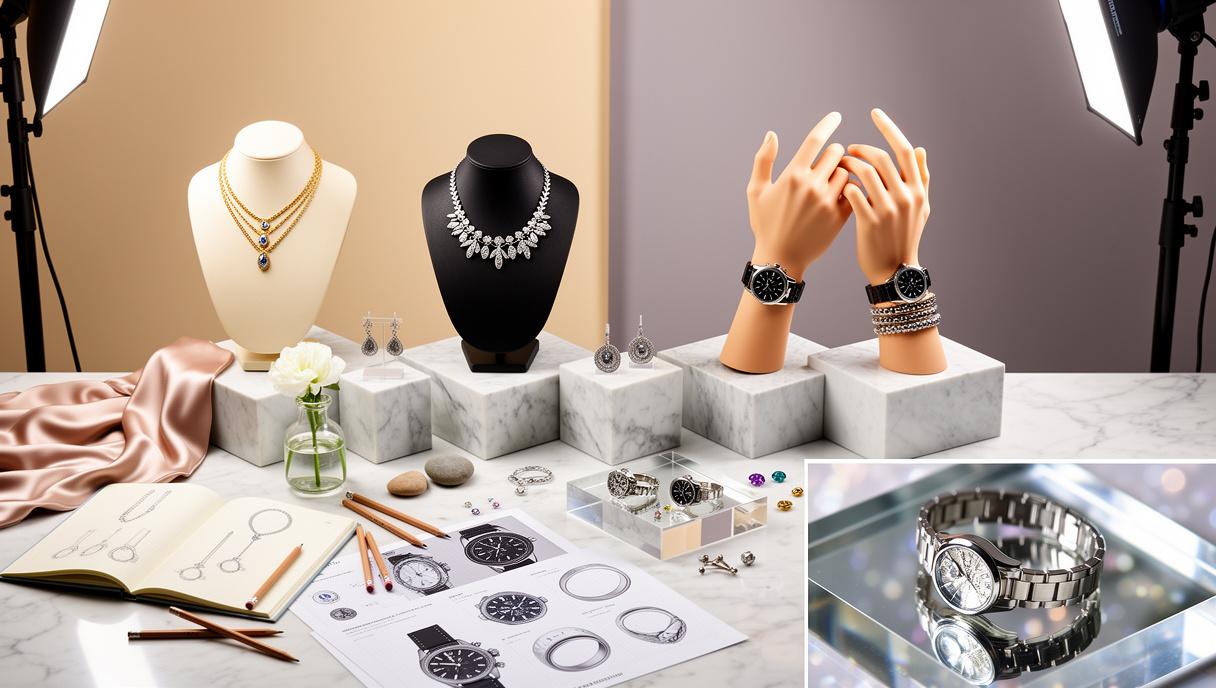
Building an AI-First Jewellery Content Workflow: From CAD to Launch-Ready Visuals
An AI-first workflow begins with asset discipline. Organize product inputs into three streams: sketch, CAD, and sample photography. For sketches, ensure clean outlines and color notes. For CAD, export high-resolution views and material callouts—metal types, stone cuts, and surface finishes. For photos, capture a neutral-lit reference frame for each SKU to anchor color accuracy. These inputs give AI the scaffolding needed to render believable metals and stones across campaign types.
Next, define output sets by commercial need. Most teams start with consistent packshots in three to five angles—front, three-quarter, side, macro of key detail, and worn-scale if relevant. Then expand to lifestyle scenes and on-model variations: hand, neck, ear, or wrist, aligned to brand tone. Create naming conventions for hero, detail, and scale images so PDPs and marketplaces auto-map assets correctly. With AI, once angles and style presets are finalized, generating the entire collection becomes push-button, ensuring seasonal refreshes remain cohesive.
Dial in realism with material-first settings. Metals need subtle anisotropic highlights and clean horizon reflections; stones require precise dispersion and internal reflections that avoid “glass marble” artifacts. Use reference charts for yellow, white, and rose gold to lock in hue and luminance. On watches, watch out for dial legibility, anti-reflective glare, and consistent hand positions. For chains, simulate natural drape and gravity so links neither fuse nor float. Small corrections—shadow density under rings, fingertip tone in on-model shots—elevate credibility immediately.
Optimize for channels early. For e-commerce, output 2K to balance clarity and load time; for print or hero billboards, generate 4K masters. Use non-destructive smart edits so the same base image can be repurposed with different crops for PDP zoom, social reels, and marketplace aspect ratios. Export multiple backgrounds: pure white for marketplaces, light gray for brand stores, and editorial environments for ads. Maintain metadata for SKU, collection, metal, and stone so DAMs, PIMs, and storefronts can index assets automatically.
Quality assurance closes the loop. Review sparkle balance across gemstones, check that prongs, bezels, and settings are intact, and confirm that carat-equivalent scale matches product specs in on-model shots. A quick A/B test—AI vs. traditional studio imagery—often shows higher click-through on AI portraits due to lighting consistency and brand-synced styling. Finally, enrich SEO with descriptive alt text, structured filenames, and page copy that highlights material, craft technique, and care—elements that increase both ranking and customer confidence.
Performance, ROI, and Real-World Scenarios: What Teams See After Switching
Consider a boutique jeweller launching a 120-SKU collection across rings, pendants, and earrings. Traditional production might require multiple shoot days, model bookings, re-shoots for color variants, and weeks of retouching. An AI-driven pipeline brings that timeline down dramatically: once the style system is approved, generating angles, creating worn-scale images, and building lifestyle campaigns becomes a repeatable process. The result is faster product page activation, synchronized campaign rollouts, and the flexibility to test multiple art directions without committing to physical sets.
In multi-market scenarios—London, New York, Dubai—AI simplifies localization. On-model imagery can reflect regional styling norms while keeping the core product untouched. Backgrounds, hand tones, and prop details can shift to resonate with local culture and seasonality, all while preserving SKU-level consistency for global catalogues. This is powerful for retailers operating both boutique and online channels, who need agility to update imagery for holidays, capsule drops, and collaborations without building new sets from scratch.
Product development benefits, too. With concept-to-reality rendering, teams validate designs before sampling. Stakeholders review realistic metals and stones from CAD or sketch, and pre-sell limited runs with confidence. That shortens cash cycles and reduces overstock. For high-ticket items, AOIs—angles of interest like under-gallery, clasp details, and hallmarks—can be shown clearly to reduce pre-purchase friction. When customers understand what they are buying, returns go down, and loyalty goes up.
Operationally, cost centers shift from logistics to creative exploration. Instead of shipping pieces to studios, scheduling models, or rushing last-minute edits, teams invest time in refining brand lighting, color harmony, and set direction. Sustainability also improves: fewer shipments and physical sets mean a lower footprint, a growing consideration for luxury shoppers. Legal and brand governance remain straightforward—product remains accurate, and if synthetic models are used, they reflect real-world body proportions and skin textures responsibly.
Realistic expectations matter. AI is not a magic button; it is a precision tool. The strongest results come from clear style guides, correct material references, and a few high-quality seed images to lock in color and facet behavior. When that foundation is in place, the payoff is measurable: faster time-to-launch, cohesive catalogues that strengthen brand equity, and creative capacity that scales with the line. For many teams, the shift to AI-first production becomes the difference between chasing content and leading with it—turning every stone and setting into a story that converts.

Sofia cybersecurity lecturer based in Montréal. Viktor decodes ransomware trends, Balkan folklore monsters, and cold-weather cycling hacks. He brews sour cherry beer in his basement and performs slam-poetry in three languages.